An exploration of how Globus could support controlled data sharing with external collaborators.
This work explores a Globus-based architecture for collaboration scenarios where data needs to be exchanged in a way that is structured, scalable, and easier to govern. The design is based on Globus concepts and structure, using them to built a sharing pattern suited to our needs.
As part of this investigation, we also developed a starter kit; an API-focused exploration. That repository captures a more implementation-oriented outcome of this work, showing how Globus components such as gateways, mapped collections, and guest collections can be configured using service credentials, roles, and ACL-based access control.
Proposed sharing model
The proposed model follows an always-pull approach, where data is exposed in a controlled staging location and pulled by the external collabs. This is intended to support both one-off sharing of a defined dataset and longer-running program sharing where data is exchanged over time within an agreed scope. In both cases, sharing is expected to be governed by an agreement defining, among other things, the underlying sharing structure
Architecture and naming
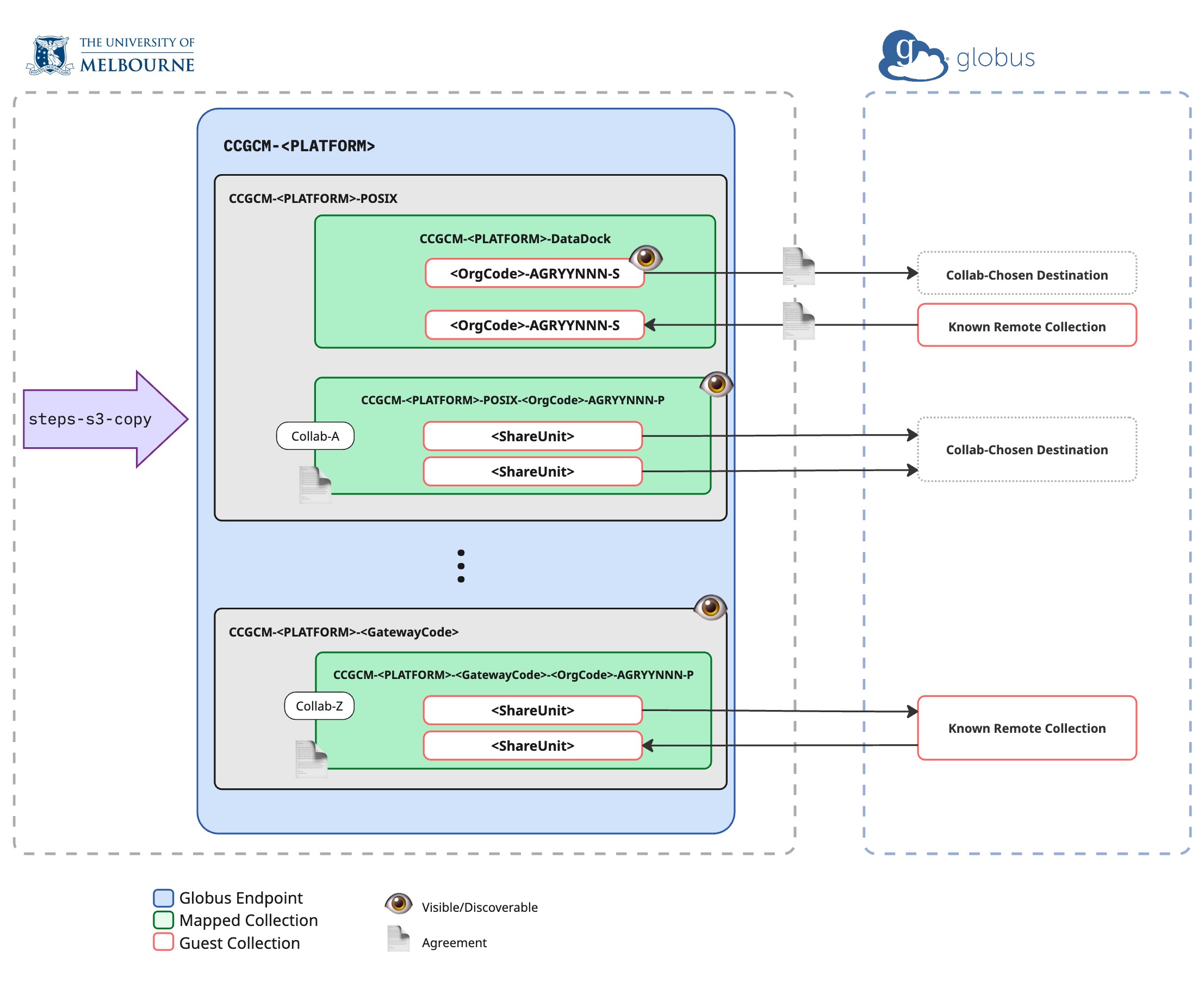
A key part of the proposal is the use of a consistent naming convention that carries the mapping between the proposed sharing model and the Globus structures used to implement it. The convention is intended to be both logical and human-readable, while supporting easier discovery and traceability of resources across the sharing structure.
In the proposed model, a Globus endpoint would be deployed on each platform where sharing needs
to occur (e.g., AWS), with endpoint names following the pattern CCGCM-<Platform>. Each
endpoint would contain a default mapped collection named
CCGCM-<Platform>-DataDock, which would act as the staging area for one-off sharing.
Single exchanges would then be exposed through guest collections under that mapped collection,
with names such as <OrgCode>-AGR<YY><NNN>-S, linking the share to
the collaborating organisation.
For longer-running program sharing, a similar convention is used. Dedicated mapped collections
would be created for each program arrangement, with names that capture the platform, gateway context,
organisation, andagreement, for example
CCGCM-<Platform>-<GatewayCode>-<OrgCode>-AGR<YY><NNN>-P.
Guest collections and share units within those mapped collections would then follow the
agreement-defined collaboration structure, commonly aligned to projects or sub-projects.
As shown below, endpoints provide the platform hosting layer, mapped collections define the managed sharing surfaces, and guest collections are the access points through which permissions are granted in line with the sharing arrangements defined for a specific one-off or program share. This allows sharing to be scoped and controlled at the collection level, while keeping the underlying storage and platform details behind the managed Globus structure.